5 Signs Your Business Website Needs a Redesign Right Now
Most business owners know, somewhere in the back of their mind, that their website is past its prime. They just keep pushing the decision further down the list. The problem with that is that a website you’re not proud of is one your customers aren’t impressed by either — and some percentage of them are clicking away before they ever reach out.
Here are five signs that your site has crossed from “could be better” into “actively costing you business.”
1. It Looks Dated on Mobile
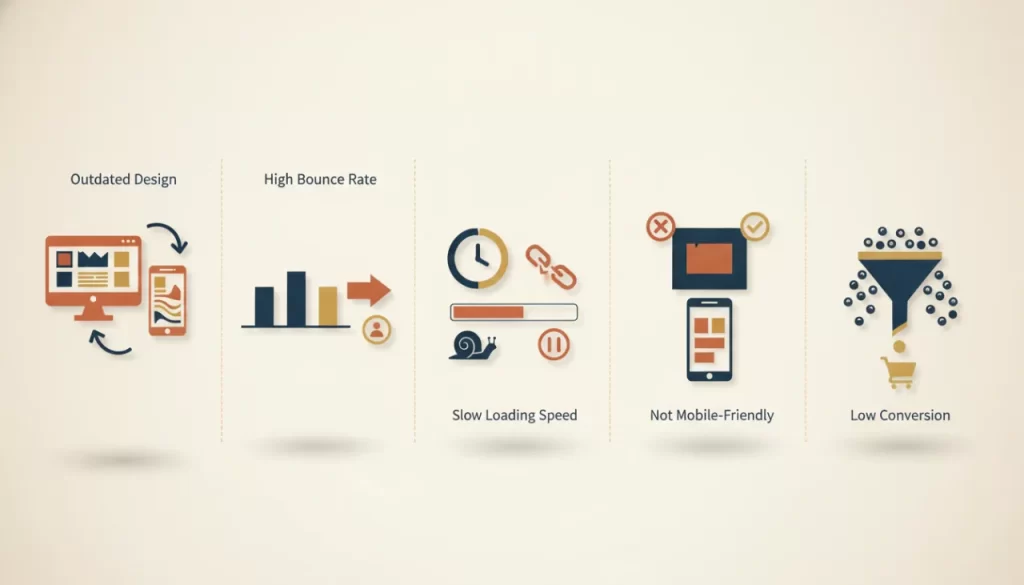
Pull up your website on your phone and be honest about what you see. If text is tiny, images are clipped, buttons are hard to tap, or the layout feels like it was designed for a desktop screen that got squashed — it’s a problem. More than half of all web traffic comes from phones. In local search especially, the majority of searchers are on mobile, often looking for a business while they’re already out.
A site that’s difficult to use on a phone doesn’t just frustrate visitors — it signals to Google that the experience isn’t good, which pushes you down in mobile search results. The two problems compound each other.
2. It Loads Slowly
You can test your load time for free with Google’s PageSpeed Insights. If your site is scoring in the red — or even just solidly in the yellow — you’re losing visitors before the page even finishes loading. Research consistently shows that most mobile users won’t wait more than a few seconds for a page to load.
Slow sites are usually the result of unoptimized images, cheap shared hosting, bloated page-builder plugins, or all three at once. A redesign done right addresses all of these at the foundation level, not as patches applied afterward.
3. It Doesn’t Reflect What You Actually Offer
Businesses evolve. Services change, teams grow, pricing shifts. But websites often get frozen at a moment in time — typically whatever the business offered when the site was first built. If a prospective customer calls and asks about something they didn’t see on your site, or if a competitor’s site clearly offers something yours doesn’t mention, you’re working with outdated information.
This one cuts deeper than just being out of date. An inaccurate website erodes trust. Visitors who sense a disconnect between your site and your actual business will second-guess whether you’re the right call.
4. It Generates Little to No Leads
A website should be your hardest-working salesperson — present 24 hours a day, seven days a week, converting visitors into calls and form fills without requiring any effort from you. If your site gets traffic but the phone doesn’t ring, something is broken in the conversion chain. Maybe the call-to-action is buried. Maybe the phone number isn’t clickable on mobile. Maybe the contact form hasn’t worked in months and nobody told you.
Check your Google Analytics for bounce rate and goal completions. If visitors are landing and leaving without taking any action, the site is failing at its core job.
5. You’re Embarrassed to Share It
This is the simplest diagnostic of all. When you’re networking and someone says “I’ll look you up” — do you feel confident about what they’ll find, or do you quietly hope they forget? If you’re hesitant to hand out your URL, that’s your gut telling you something your analytics might not.
Your website is often the first impression a prospective customer forms of your business. It either builds confidence or it erodes it. There’s no neutral — a website that looks like it was built years ago on a budget says something about how you run your business, whether that’s fair or not.
What to Do Next
If any of these five signs hit close to home, the solution isn’t to patch the existing site — it’s to build it right. A proper website redesign addresses all of these issues at once: mobile experience, page speed, accurate content, conversion design, and a look you’re proud to share.
Our custom website builds start with your goals — calls, form fills, bookings — and work backward from there. Get in touch and we’ll take a look at your current site and tell you exactly where it’s falling short.
Frequently asked questions
How often should a business website be redesigned? +
There’s no fixed rule, but most business websites need meaningful updates every three to five years to stay current with design expectations, mobile standards, and SEO best practices. A site that was built before Google’s Core Web Vitals rollout likely needs attention now.
Will a redesign hurt my current Google rankings? +
A poorly executed redesign can hurt rankings if URLs change without proper redirects or if SEO structure is ignored. A well-planned redesign with an SEO migration checklist typically maintains or improves rankings because the new site is technically stronger.
How long does a website redesign take? +
A thorough custom redesign typically runs four to eight weeks from kickoff to launch, depending on the complexity of the site and how quickly content is gathered. Simpler sites can move faster.
Can I keep my current content in a redesign? +
Yes, existing content that’s performing well in search should be preserved and migrated carefully. A good redesign improves the content and structure while keeping what’s already working.