The 7-Page Website Every Texas Service Business Needs
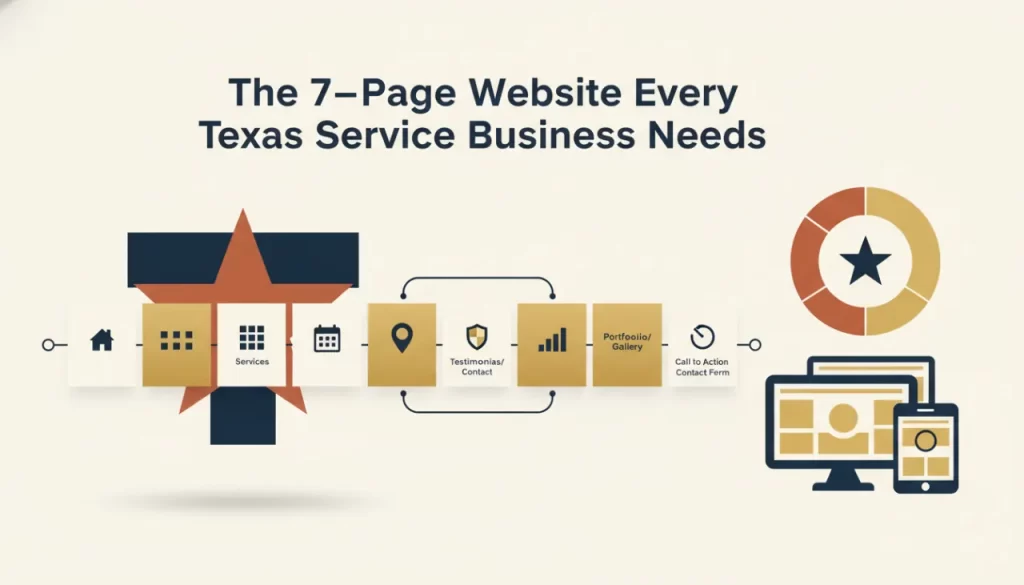
A lot of service business websites suffer from one of two extremes: a sprawling site with dozens of thin pages that say nothing, or a single-page site where everything is crammed together in a way that helps neither the visitor nor Google. The sweet spot for most local Texas service businesses is a focused, well-organized site with a small number of pages that each do a specific job.
Here’s the core page structure we recommend — and what every page must accomplish to earn its place on your site.
1. Homepage
Your homepage is your handshake. It’s not supposed to explain everything — it’s supposed to orient the visitor, communicate your core value in seconds, and point them toward the next step. A strong homepage includes: a clear headline that names who you serve and what you do, your service area, a primary call to action above the scroll, and trust signals (reviews, years in business, key credentials) visible without scrolling too far.
2. Dedicated Service Pages (One Per Service)
This is where most service businesses underinvest. Listing all your services on one long page is a missed opportunity — both for your customers and for Google. A roofing company that offers roof repair, roof replacement, gutter installation, and storm damage restoration should have a separate page for each. Here’s why:
- Each page can be optimized for its own search terms
- Visitors looking for one specific service don’t have to hunt through a list
- Google can understand the depth of your expertise in each area
Our custom website builds always include dedicated service pages as part of the site architecture.
3. About Page
The About page is consistently one of the highest-traffic pages on a local business site. People who are considering hiring you want to know who they’re dealing with. Not a corporate history — a real story about who you are, why you started the business, and what you care about. Include a photo of the owner and/or team. For service businesses built on trust (medical, legal, childcare, trades), a compelling About page directly influences whether someone picks up the phone.
4. FAQ Page
A well-constructed FAQ page does two things: it answers the questions your customers are already typing into Google (which means it can rank for those exact searches), and it reduces the friction of the decision to hire you. Document the questions you actually get on first calls. Price ranges, timelines, what’s included, what to expect — answer them honestly and specifically. Vague answers signal vague service.
5. Contact Page
Your contact page should make it dead simple to reach you in the way you prefer to be reached. Phone number in large, tappable text. A form that asks only for what you actually need (name, phone, brief description of the project is usually enough). Business hours. If you serve a specific area, say so clearly. Do not require people to fill out eight fields to ask a simple question.
6. Areas Served / Location Pages
This is often the most underdeveloped part of a service business website, and the most consequential for local SEO. If you serve multiple cities or regions, each one deserves its own page — not a boilerplate list, but a real page that speaks to that community and links to your specific services in that area. Our local SEO service includes building and optimizing location pages that rank for city-specific searches. See our Texas service area pages as a model for how this is done well.
7. Portfolio or Project Gallery
For trades, contractors, designers, landscapers, or any business where the work is visible — a portfolio page is powerful. Real photos of completed projects build credibility faster than any text. Add brief descriptions with location context and you’ve also added useful local content Google can index.
Why Focused Pages Beat Crammed Pages
The temptation is to put everything on as few pages as possible. Resist it. A page that tries to do everything does none of them well. More focused pages with clear purposes rank better, convert better, and are easier for visitors to navigate.
If you’re not sure your current site is structured to perform, we’re happy to take a look. Reach out and we’ll give you an honest assessment of what’s working and what isn’t.
Frequently asked questions
Do I really need a separate page for every service I offer? +
Yes, for your primary services. Giving each service its own page lets Google understand exactly what you do in depth, and lets visitors find the specific service they need without hunting. As a practical guide: if a customer might search for it specifically, it probably deserves its own page.
How many pages does a typical service business website need? +
Most local service businesses are well served by 10–20 focused pages: a homepage, 4–8 service pages, an about page, an FAQ, a contact page, and 2–5 location pages for their primary service areas. More pages are fine if each one has a clear purpose and unique content.
Should I have a blog on my service business website? +
Yes, if you’ll actually publish content regularly. A blog that’s updated consistently builds topical authority and creates content that ranks for the informational searches your potential customers are making. A blog with three posts from 2021 and nothing since signals neglect — which can hurt trust more than help it.
What makes a location page different from just mentioning a city name on a page? +
A real location page has unique content specific to that city or area — local references, service-specific information for that market, and a genuine reason for a visitor from that area to find it useful. Thin pages that just repeat ‘We serve [City]’ with boilerplate content don’t rank and don’t convert.