Keyword Research for Texas Small Businesses: A Practical Framework
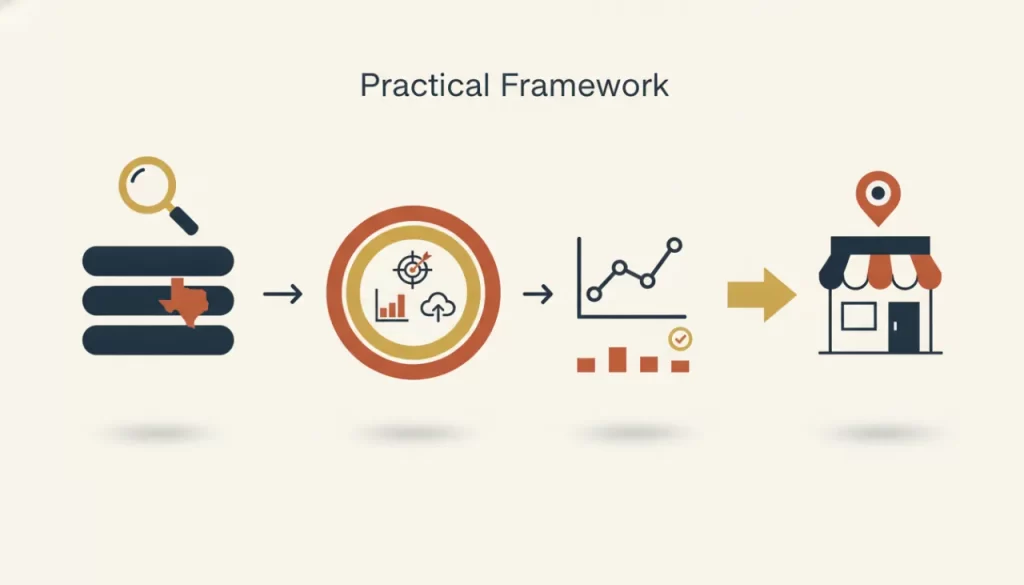
Most small business owners think keyword research is something an SEO agency does with expensive software. In reality, the most valuable keywords for your business are the phrases your best customers type when they’re ready to hire someone — and you probably already know half of them. What a structured keyword research process gives you is confidence that you’re targeting the right phrases, not just the ones that feel right.
Start With Your Customer’s Language, Not Your Own
The most common keyword research mistake: using industry terminology instead of customer language. A roofing contractor might call it “TPO membrane application,” but a homeowner searching for it calls it “flat roof repair.” A dentist might offer “maxillofacial surgery,” but patients search “wisdom tooth removal near me.”
To find customer language: think about the last ten calls you got from new customers. What words did they use to describe their problem? What questions did they ask? Those are keywords. Write them down before you touch any tool.
Use Free Tools That Are Already Available
You don’t need to pay for a keyword tool to start. These free resources give you real data:
- Google Autocomplete. Start typing a phrase related to your service into Google and watch what it suggests. These are real searches people are making right now. Pay attention to the “People also ask” section — those are keyword-rich questions worth building content around.
- Google Search Console. If your site is already getting some organic traffic, Search Console shows you exactly what queries are generating impressions and clicks. This is gold — it’s your real audience’s real behavior.
- Google’s related searches. Scroll to the bottom of any search results page. The related searches shown there are additional keyword variations worth considering.
- Ubersuggest (free tier) and Google Keyword Planner (free) provide volume estimates and related keyword ideas without a subscription.
Understand Keyword Intent
Not all keywords are equal. Before you target a phrase, understand what the searcher wants when they type it:
- Transactional intent: The searcher is ready to hire or buy. “HVAC repair Dallas” or “plumber near me” — these are your highest-value targets. Build service pages around them.
- Informational intent: The searcher wants to learn. “How do I fix a leaky faucet” or “how much does a roof replacement cost” — these are great for blog posts that build trust and capture people earlier in the decision process.
- Local intent: The searcher specifically wants a local business. “Web design company Austin” or “dentist in Fort Worth.” These are location-specific service keywords and deserve their own local SEO strategy and dedicated pages.
Look at What Competitors Are Ranking For
Run a Google search for your top competitors. What pages do they have? What topics do they write about? What questions do they answer? You’re not copying them — you’re identifying the keyword landscape and finding gaps they haven’t addressed. A competitor ranking for “commercial HVAC maintenance Dallas” but not covering Plano or Irving is an opportunity for a more targeted business.
Build a Simple Keyword Map
Once you have a list of keywords, assign them to pages. Every important keyword should have one dedicated page on your site. The most common mistake: trying to rank one page for too many different keywords, or not having a page at all for an important term. A basic keyword map looks like this:
- Homepage: your primary brand and broad category keyword
- Each service page: one core transactional keyword per service
- Each location page: “[service] in [city]” for each market you target
- Blog posts: informational and comparison keywords that your service pages don’t cover
Prioritize by Competition and Opportunity
A keyword with massive search volume isn’t useful if it’s dominated by national brands you can’t compete with. Focus on the intersection of relevance, intent, and achievability. For most Texas small businesses, that means hyper-specific service and city combinations and long-tail phrases that large competitors overlook.
Keyword research is the foundation of both your SEO strategy and your content plan. If you want a professional keyword audit that maps the full opportunity for your specific business and market, get in touch with us. We’ll show you exactly what your customers are searching for — and which of those searches you could own.
Frequently asked questions
How many keywords should I target on a single page? +
One primary keyword and a handful of closely related variations. Trying to rank one page for dozens of different keywords dilutes the page’s relevance signal and confuses both visitors and search engines. If you have many important keywords, build multiple pages — each focused on a specific topic or service.
Does keyword density still matter for SEO? +
No — not as a percentage metric. The old practice of hitting a specific keyword density number is outdated. Write naturally for a human reader, include your target phrase where it fits naturally (title, headings, first paragraph), and focus on covering the topic comprehensively. Google’s understanding of language has advanced well beyond counting keyword repetitions.
Should I target keywords with zero monthly search volume? +
Sometimes, yes. Very specific long-tail phrases — especially service and city and qualifier combinations — may show zero volume in keyword tools because searches are too sparse to register, but they still happen. A page targeting “industrial refrigerator repair San Marcos Texas” might get only a few searches a month — but if those searchers are ready to spend several thousand dollars, that page pays for itself.
How often should I revisit my keyword strategy? +
A thorough review twice a year is a solid cadence for most small businesses. More frequently if you’re in a rapidly changing market or adding new services. Google Search Console data is your best feedback loop — check it monthly to see what queries are driving impressions, and use that to refine your targeting.