Restaurant Websites That Fill Tables: What the Best Ones Do Differently
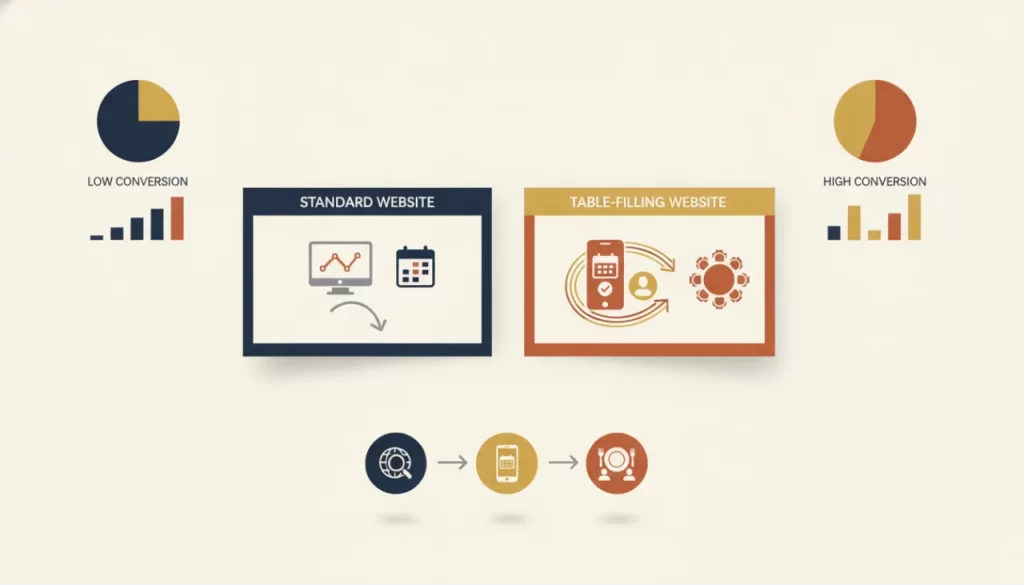
Restaurants have one of the most unforgiving web design problems in local business. A potential customer searches for dinner options at 6:30 PM, finds your site, and makes a decision in about eight seconds. If they can’t see the menu, find the hours, or figure out where you are — they’re already looking at the next result. Let’s talk about what actually makes a restaurant website work.
The Menu Problem: Stop Using PDFs
Uploading your menu as a PDF is one of the most common and costly restaurant website mistakes. PDFs don’t load well on phones, can’t be read by Google, and frustrate hungry customers who just want to see what you offer. Build your menu in HTML — properly formatted, easy to read on a phone, and crawlable by search engines. Update it when things change. A current, readable menu is one of the first things customers look for, and a broken or outdated PDF creates immediate distrust.
Hours, Location, and Contact Information — Everywhere
Your address, phone number, and current hours should appear on every page of your website — not just the contact page. Someone landing on your about page or menu page shouldn’t have to navigate to find you. Put them in the header or footer. Include a Google Maps embed on your contact page. Make sure your Google Business Profile hours match your website hours exactly — a mismatch confuses customers and undermines your local SEO.
Photography: Your Most Important Content
Restaurant websites live and die on photography. If your food doesn’t look appetizing online, you’ve lost the sale before anyone walks in the door. Professional food photography is not optional for a restaurant serious about driving revenue from its website. You don’t need fifty photos — ten to fifteen excellent images of signature dishes, your dining room, and your team tell the story far better than a hundred mediocre phone snapshots.
San Antonio and Austin restaurants operate in markets with strong dining cultures and sophisticated customers. In those markets especially, the photo quality bar is high. A well-photographed website signals that the food and experience will match.
Online Reservations and Ordering: Remove the Friction
If you take reservations, integrate OpenTable, Resy, or a comparable platform directly on your site. A “call us to reserve” instruction costs you bookings from customers who prefer not to call. If you offer takeout or delivery, integrate an ordering platform — or link clearly to where customers can order. Every step of friction between “I want this” and “I bought this” costs you revenue.
Local SEO Basics for Texas Restaurants
Restaurant searches are overwhelmingly local and mobile. “Best tacos in San Antonio,” “breakfast near me in Austin,” “waterfront dining Houston” — these are the searches that put tables in seats. Getting into the Map Pack for your cuisine type and neighborhood requires:
- A fully optimized Google Business Profile with current hours, menu link, and frequent photo updates
- Consistent NAP information across Yelp, TripAdvisor, OpenTable, and other directories
- Location and cuisine keywords in your page titles, headers, and content
- A review strategy — more on that below
Our local SEO services address all of these for Texas restaurants and hospitality businesses.
Google Reviews: Your Online Word of Mouth
Restaurant-goers rely on reviews more heavily than almost any other consumer category. Your review count, rating, and recency all influence both search rankings and customer decisions. Train your staff to ask happy customers to leave a Google review. Respond to every review — thank the positive ones specifically, address the negative ones professionally and without defensiveness. An engaged review profile signals a restaurant that cares, which is exactly what a first-time customer wants to see.
Texas Restaurant Markets Worth Knowing
San Antonio’s tourism economy means out-of-town visitors searching for dining are a real audience — optimize for terms that capture tourists, not just locals. Austin’s dining scene is intensely competitive and trend-driven; leaning into your specific identity and neighborhood is more effective than trying to rank for broad terms. Houston’s geographic spread means neighborhood-specific SEO (Montrose, The Heights, Sugar Land) outperforms city-wide targeting. If you serve the San Antonio area, our local team knows those search dynamics well.
Turn Your Website Into a Revenue Driver
A great restaurant website works the way a great front-of-house team works: it makes people feel welcome, answers their questions quickly, and makes it easy to say yes. Most restaurant sites are doing the opposite. If you’re ready to fix that, explore our custom restaurant website options or reach out for a quick conversation about what your specific situation needs.
Frequently asked questions
Should I build my restaurant website on a platform like Squarespace or hire a professional? +
DIY builders can work for very small operations with limited budgets. But restaurant sites need to load fast, integrate booking and ordering tools, and rank in competitive local search — all areas where a professionally built site on a proper platform outperforms a DIY template significantly.
How often should I update my restaurant website? +
Update the menu whenever it changes. Update photos seasonally if you have the content. Keep hours, holiday closures, and special events current. Stale websites lose trust quickly — an outdated hours listing is one of the most common reasons restaurants lose customers before they even visit.
Does having a Yelp page replace needing a website? +
No. Yelp and Google Business Profile are supplementary — they support your website, not replace it. You don’t control your Yelp page, can’t customize the experience, and can’t optimize it for SEO the way you can a website you own.
What’s the most important page on a restaurant website? +
The menu page and the contact/location page tie for most important. Customers come to your site to see what you serve and to confirm where you are and when you’re open. Make both of those pages exceptionally clear and easy to use.