How Texas Retailers Can Compete Online Against Amazon and Big-Box Stores
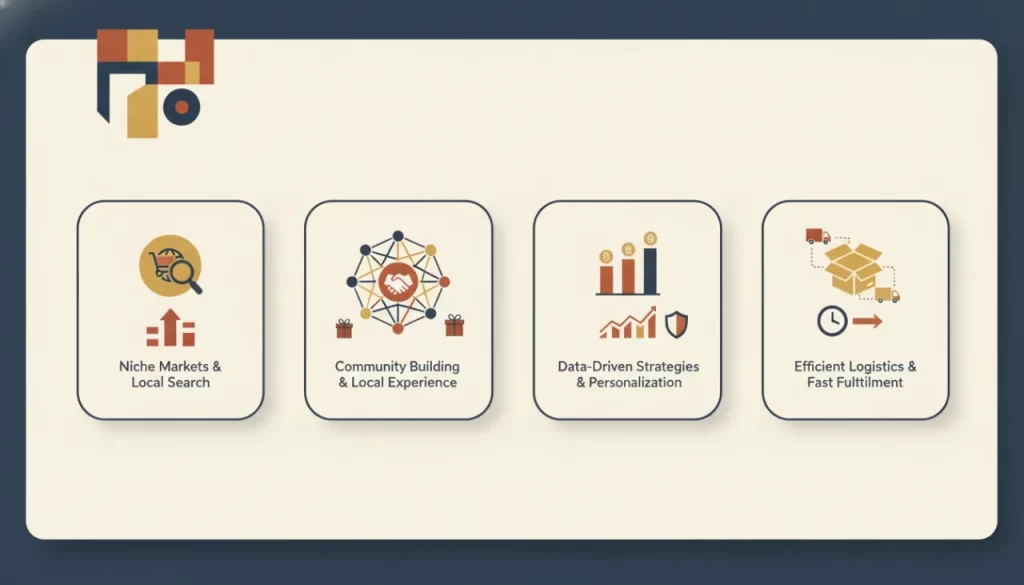
Every independent Texas retailer has heard the same worried question: how do you compete with Amazon? The honest answer is that you mostly don’t — not on price, not on shipping speed, not on product volume. But that’s not actually the contest. The customers who choose a local specialty retailer over a marketplace aren’t looking for the cheapest price. They’re looking for expertise, story, trust, and community. Your job online is to show up for those buyers clearly, before they settle for a box shipped from a warehouse.
Own the Local Search Terms Amazon Can’t Win
Amazon doesn’t have a Google Business Profile for your city. It doesn’t show up when someone types “outdoor furniture store San Antonio” or “locally made pottery Austin TX.” Those local searches go to businesses that have invested in local SEO — and there’s no reason that business can’t be yours.
Start with your Google Business Profile. Make sure it’s fully built out with correct hours, accurate category, photos of your actual store and products, and a compelling description. Then build your website around the search terms your local customers use — not generic product terms, but location-specific ones. “Western boots store Fort Worth” is a phrase Amazon won’t ever own.
Turn Your Story Into a Brand Asset
A family-owned boutique in Fredericksburg that’s been open for thirty years has a story that no marketplace can replicate. So does a specialty food shop in Houston’s Heights neighborhood, or a custom furniture maker in Tyler. That story belongs on your website — prominently, genuinely, without apology.
Introduce the people behind the business. Explain why you carry the products you carry. Show what the experience of shopping with you actually looks like. These things don’t just build emotional connection — they build the kind of E-E-A-T signals that help Google understand your site is trustworthy and worth ranking.
Your E-Commerce Site Is Infrastructure, Not a Side Project
If you’re selling physical products, a functional online store isn’t optional anymore. It doesn’t need to carry your full inventory — but it should carry your best sellers, your most searchable products, and anything that ships easily. Click-and-collect (buy online, pick up in store) has become a baseline expectation for Texas shoppers, and it bridges your physical and digital presence without requiring full shipping logistics.
Platform choice matters. WooCommerce on WordPress gives you the most flexibility and the best long-term SEO control. Shopify works well if you want a faster setup and don’t mind the recurring platform fees. Either way, your product pages need real descriptions — not manufacturer copy-paste — and original photos. Both matter for search rankings and conversion.
Lean Into What Amazon Can’t Provide
Curation is your advantage. Amazon has everything; you have the right things for your customer. Make sure your website communicates your expertise in the niche — through buying guides, product recommendations, and content that positions you as the authority your customers already know you to be.
Reviews are also critical. Local customers trust reviews from other local customers. Build a habit of asking happy buyers to leave a Google review. Respond to every review, positive or negative. This creates a virtuous cycle: more reviews drive more visibility, which drives more customers, which drives more reviews.
Bilingual Opportunities in Texas Markets
If your store is in a market with a significant Spanish-speaking population — and in much of Texas, it is — a bilingual website or at least bilingual product descriptions can open a meaningful competitive gap. This is especially true in Houston, San Antonio, El Paso, and the Rio Grande Valley, where retailers who communicate in both languages reach buyers their competitors miss entirely.
If you’re ready to build an online presence that matches the quality of your in-store experience, our e-commerce web design service is built for exactly that. We also offer local SEO services to help Texas retailers show up for the searches that matter. Get in touch and let’s talk through what makes sense for your business.
Frequently asked questions
Do I need a full e-commerce site or can I just use a Facebook shop? +
A Facebook or Instagram shop can supplement your sales, but it shouldn’t be your primary online presence. You don’t own those platforms, their algorithms change without warning, and they offer almost no SEO benefit. A proper website with e-commerce capability builds an asset you control and that compounds over time through search traffic.
What’s the best e-commerce platform for a small Texas retailer? +
WooCommerce on WordPress gives the most long-term flexibility and SEO control. Shopify is a solid choice if you want faster setup and less technical maintenance. The best platform is the one you’ll actually use and keep updated — platform capability only matters if you execute on it.
How do I compete with big-box stores on Google? +
By targeting the searches they’re not winning. National chains dominate broad terms, but they rarely own hyper-local searches (‘specialty running store Plano TX’), category-plus-location combinations, or long-tail searches that your specific expertise can answer. Local SEO and content strategy are your best tools here.
Should I invest in local SEO or paid ads first? +
If your budget is limited, invest in local SEO first. It builds lasting visibility that compounds over time. Paid ads generate immediate traffic but stop the moment you stop paying. Once your SEO foundation is solid, paid ads can be a useful accelerator — but not a replacement for organic rankings.