Web Design Pricing Models: Flat Fee vs. Monthly vs. Per-Hour
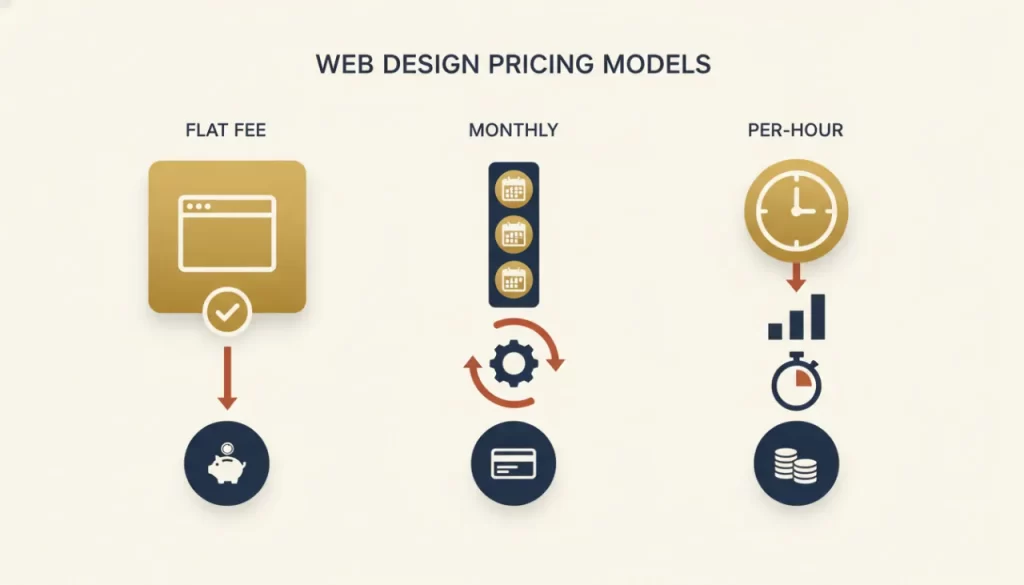
When you start getting web design quotes, you’ll quickly notice that different agencies charge in completely different ways. One gives you a flat number: $5,500, done. Another charges $350 a month with no end date. A third tracks hours at $125 each and tells you they’ll give you an estimate. All three models have legitimate use cases — but they also have traps. Here’s how to tell them apart.
The Three Main Pricing Models
Flat-Fee Project Pricing
You pay an agreed amount for a defined scope of work. Design, development, copywriting, and launch — all bundled into one number with a clear deliverable at the end.
The upside: You know exactly what you’re spending. There are no invoices that creep up month after month. A well-scoped flat-fee project gives both you and the agency a shared definition of “done.”
The risk to watch for: Vague scope. If the contract doesn’t clearly define what’s included — number of pages, revision rounds, copywriting, SEO setup — the agency can charge for every addition as a separate item. Read the scope carefully.
Monthly Retainer
You pay a recurring monthly fee for ongoing design, development, and/or marketing work. Retainers range from ongoing care and updates to full-service SEO + design partnerships.
The upside: Continuous improvement and support. If you want your website treated as a living asset — regularly updated, optimized, and monitored — a retainer makes sense. Many of our clients pair an initial flat-fee build with an ongoing website care plan to get the best of both.
The risk to watch for: Retainers with no clear deliverables. Some agencies charge monthly fees but can’t tell you exactly what they did for you each month. Demand a monthly report with documented work completed.
Hourly Billing
You’re billed for time spent. The agency tracks hours and invoices you accordingly — sometimes with a not-to-exceed estimate, sometimes without.
The upside: Flexible for projects where the scope genuinely can’t be defined upfront. Good for small, targeted tasks or projects that are evolving as you go.
The risk to watch for: Hourly billing puts all the financial risk on you. A project that was “estimated” at 30 hours can easily run 50 if there’s scope creep, communication gaps, or slow approvals. For a complete website build, hourly billing is rarely in the client’s favor.
A Quick Comparison
- Flat fee: Best for defined projects — a new site build, a redesign, a specific landing page campaign.
- Monthly retainer: Best for ongoing SEO, content, maintenance, or continuous improvement after launch.
- Hourly: Best for small, one-off tasks with a clear time estimate and a provider you already trust.
Red Flags to Watch For in Any Pricing Model
Regardless of how an agency charges, these are warning signs that something is off:
- No written contract or scope document — verbal agreements lead to disputes
- “Unlimited revisions” claims without defining what a revision actually is
- Monthly fees with no clear list of what’s included each month
- Hourly quotes with no not-to-exceed cap on a complex project
- No mention of who owns the final website, content, and domain
Questions to Ask Before Signing Anything
- What exactly is included in this price — design, copy, SEO setup, and launch?
- How many pages and revision rounds does this cover?
- Who owns the site, the code, and the domain when we’re done?
- What happens if the project runs over scope?
- What ongoing support is available after launch, and at what cost?
What We Recommend for Most Texas Small Businesses
For the vast majority of owner-operated businesses, a flat-fee build followed by a monthly care plan gives you the clearest ROI. You know exactly what the site costs, you own the asset outright, and you have a predictable monthly cost for keeping it healthy and performing. It’s the model that aligns the agency’s incentives with yours: build something great, then protect it.
If you’re ready to see what that looks like in practice, visit our pricing page for a clear breakdown of what we charge and why — or reach out and we’ll walk you through it directly.
Frequently asked questions
Is a monthly retainer just a way for agencies to keep billing you forever? +
A retainer should deliver clear, ongoing value — SEO management, content publishing, performance monitoring, and site updates. If your agency can’t tell you exactly what they did each month and what it produced, that’s a problem. A good retainer is a partnership, not a subscription you forget about.
Can I negotiate a flat-fee price? +
Sometimes, but be careful about negotiating by cutting scope rather than rate. A flat fee is based on the work needed to deliver a result — cutting the price often means cutting the things that make the site actually work, like SEO setup or quality copywriting.
What should a flat-fee web design contract include? +
At minimum: a page list, number of revision rounds, what content you’re responsible for providing, a timeline with milestones, who owns the assets at completion, and what’s explicitly excluded from scope. If any of those are missing, ask before signing.
How do I compare quotes that use different pricing models? +
Convert everything to a total 12-month cost including build, hosting, maintenance, and any expected add-ons. A low monthly retainer that includes everything can sometimes be more economical than a flat fee plus separate maintenance, and vice versa. Line-item comparisons are the only fair way to evaluate.